What are REITS?
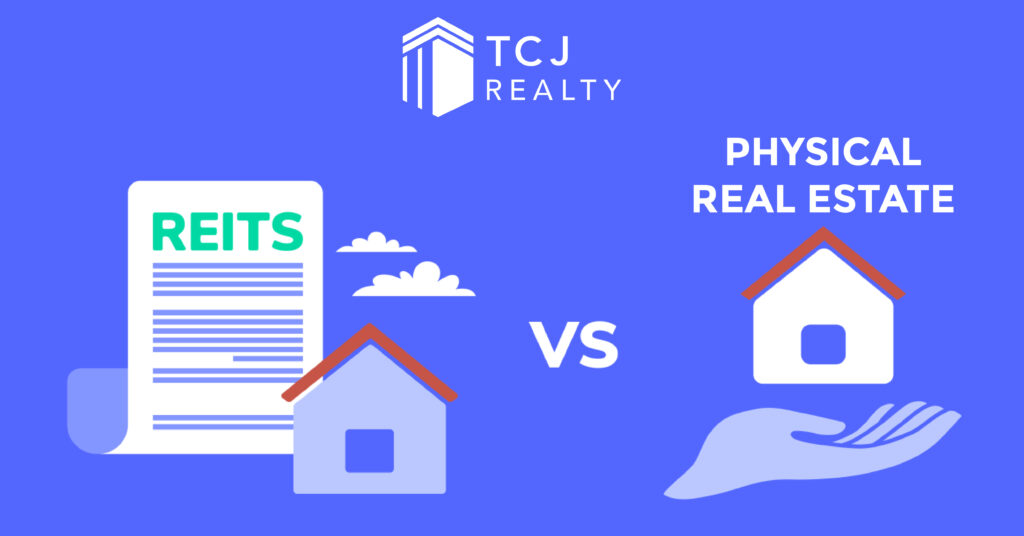
The Real estate investment trusts (REITs) are entities owning, financing, and operating real estate assets held in the manner of a mutual fund. Under this, investors pool money to buy income-generating real estate assets. REITs are presently allowed to invest only in commercial properties. These entities should have a minimum of Rs 500 crore assets while investing 80 percent of investor money in finished and revenue-generating projects. Around 90 percent of income is distributed amongst investors through dividends, while the remaining is reinvested in under-construction real estate projects.
REITs Vs Physical Real Estate
Investment required:

In general, commercial real estate requires a minimum investment of Rs 30-35 lakh and even beyond, depending upon the locality and the property. On the contrary, the minimum investment required to invest in REIT can be as low as Rs 10,000-15,000, if you are investing through a stock exchange.
However, if you intend to buy REIT shares from the primary market through Initial Public Offer (IPO), you need to shell a minimum of Rs 2 lakh.
Returns on investment:
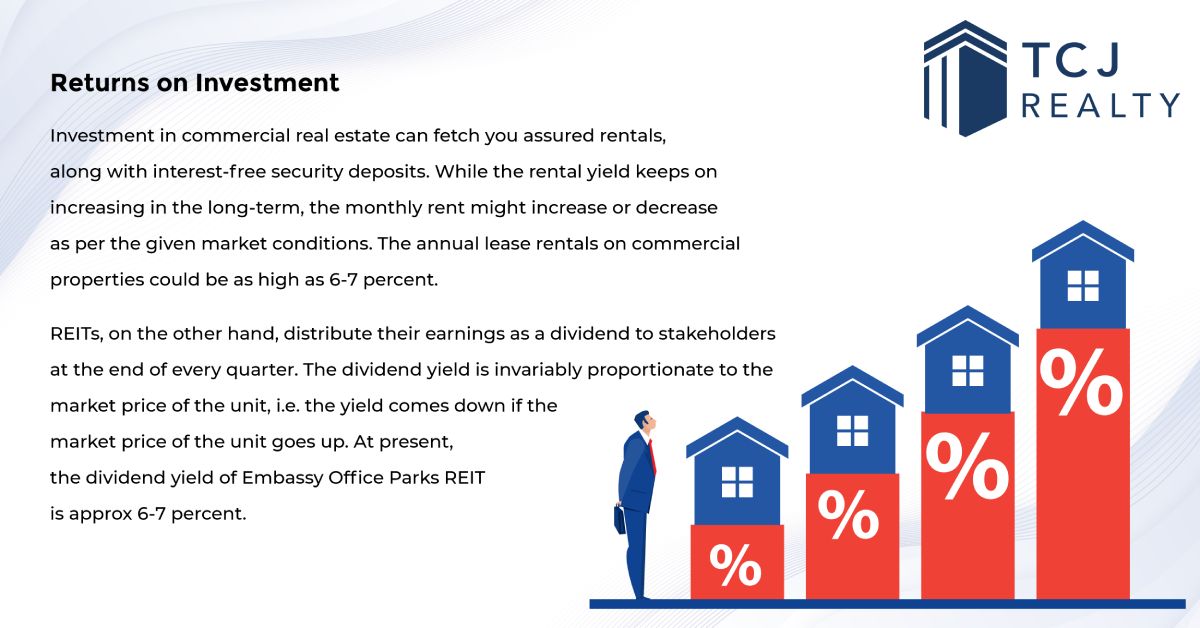
Investment in commercial real estate can fetch you assured rentals, along with interest-free security deposits. While the rental yield keeps on increasing in the long-term, the monthly rent might increase or decrease as per the given market conditions. The annual lease rentals on commercial properties could be as high as 6-7 percent.
REITs, on the other hand, distribute their earnings as a dividend to stakeholders at the end of every quarter. The dividend yield is invariably proportionate to the market price of the unit, i.e. the yield comes down if the market price of the unit goes up. At present, the dividend yield of Embassy Office Parks REIT is approx 6-7 percent.
Risk involved:
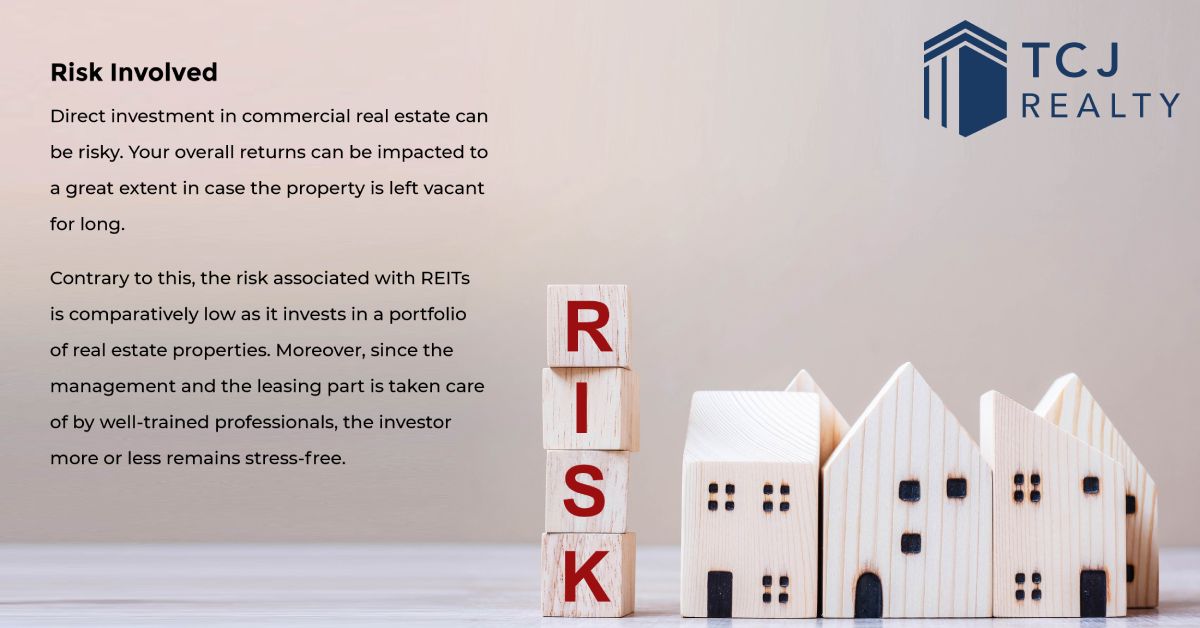
Direct investment in commercial real estate can be risky. Your overall returns can be impacted to a great extent in case the property is left vacant for long.
Contrary to this, the risk associated with REITs is comparatively low as it invests in a portfolio of real estate properties. Moreover, since the management and the leasing part is taken care of by well-trained professionals, the investor more or less remains stress-free.
Liquidity:
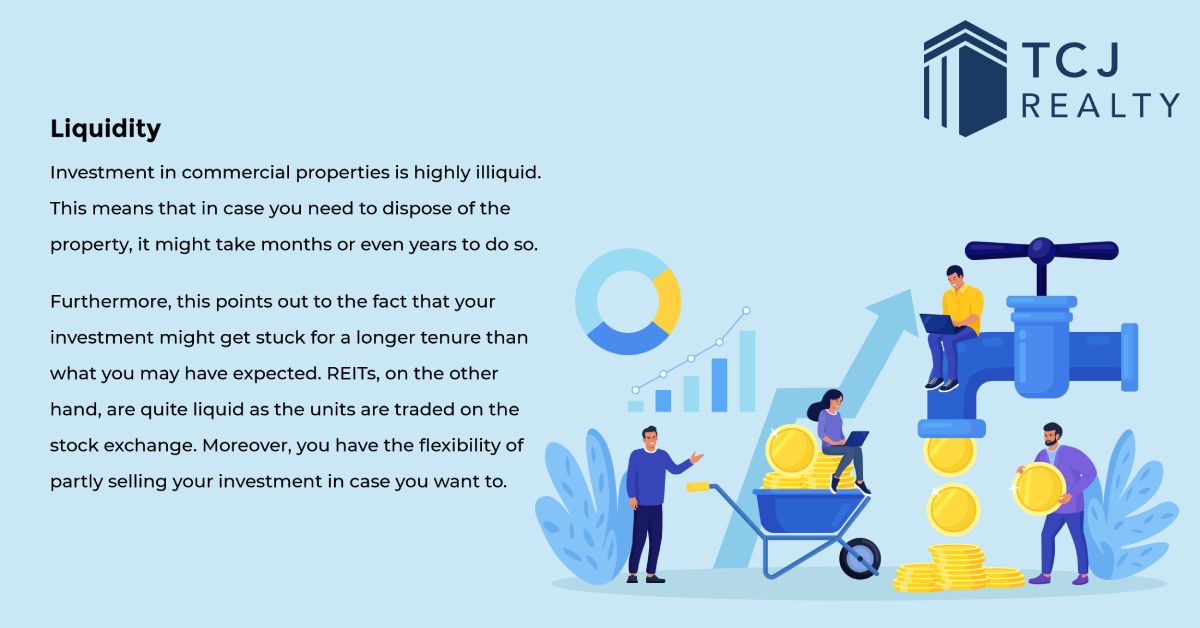
Investment in commercial properties is highly illiquid. This means that in case you need to dispose of the property, it might take months or even years to do so.
Furthermore, this points out to the fact that your investment might get stuck for a longer tenure than what you may have expected. REITs, on the other hand, are quite liquid as the units are traded on the stock exchange. Moreover, you have the flexibility of partly selling your investment in case you want to.
Fees involved:

While you need to manage the property on your own in case of direct investment in commercial real estate, it is not the case with REITs. To apprise, the maintenance and investment-related decisions of the property in case of REITs are handled by an asset manager, who charges a small fee for the work, which is usually 1-2 percent per annum.
In addition, a % percent is charged as the performance fee. (Usually Approx 20%) In the case of CRE, however, the maintenance is high, which needs to be solely borne by the owner.
The latter promises appreciation over a long span and is not affected daily, i.e. through the movement of the trade and stock market.
Since REITs are impacted by the volatility of the stock market, there is a higher rate of risk involved in it. However, the capital required for investing in REIT is quite less as compared to commercial assets.
The Securities and Exchange Board of India (SEBI) has recently reduced the minimum subscription requirement to Rs 10,000 in order to increase investor participation in REITs.
When you compare both, commercial real estate is indeed emerging as the better option as it is capable of expanding exponentially in the post-COVID-19 era.
What is better?
Both commercial real estate investments and REITs have their own pros and cons. You may consider REITs for their decent returns, comparative safety, steady income, and the opportunity to diversify your portfolio with a lower investment amount.
On the other hand, REITs are newer in the market and are traded on stock exchanges. This means risks of value fluctuations and market dynamics. Additionally, the returns are lower than direct investments, while you do not have any control over the returns or performance, unlike direct investment. REITs do offer higher liquidity and easier exits than what you can expect with direct investment in commercial real estate. Keep an eye out for higher service charges for REIT investments as well.
Commercial properties will give you higher returns and more control, although you will have to contend with direct responsibilities and liabilities. You will also get no tax benefits on your purchase while paying a significantly higher entry amount. Of course, you will benefit more from capital appreciation in the future. It is better to take professional advice before investing.
If so, you should invest in commercial real estate after assessing the risks involved. Or do you want to invest a small amount in diversifying your portfolio and REITs units that give you a steady income and higher liquidity? It all depends on your preferences.
Thus, there could be multiple facets to both the types of investments. One must comprehend their final aim for making the investment and decide which is a better option. The starting point of the decision could start from the amount you are willing to invest.
Moreover, an investment in real estate is in itself a substantial financial decision, and it would be a good idea to consult a real estate or an investment expert before going ahead.